Cushing’s disease rarely announces itself all at once. Weight settles into the face and midsection, blood pressure and blood sugar creep upward, skin bruises at the lightest touch, and mood shifts in ways that feel out of character. Many patients see several doctors before anyone connects these changes to a single source, a small tumor in the pituitary gland signaling the body to overproduce cortisol. Once that source is confirmed, focused surgical care in Los Angeles offers a clear path toward restoring hormonal balance and reclaiming everyday health.
Dr. Aaron Cohen-Gadol, founder of ATLAS Institute of Brain & Spine, brings extensive skull base experience to one of the most technically demanding pituitary conditions. He has performed more than 7,500 complex brain surgeries, pioneered over 40 neurosurgical techniques, and helped advance the endoscopic skull base approaches used to reach pituitary tumors through the nose without an external incision. His professional affiliations include the North American Skull Base Society and the Pituitary Network Association, and he is a recipient of the Vilhelm Magnus Medal, an honor awarded to only 13 neurosurgeons in history. Dr. Cohen-Gadol operates at Cedars-Sinai Medical Center and Providence Saint John’s Health Center.
“Cushing’s disease is often a very small tumor with an outsized effect on the entire body. Finding it, removing it completely, and protecting the healthy pituitary gland around it gives patients the best opportunity to feel like themselves again.” — Dr. Cohen-Gadol
Dr. Cohen gave me my life back. It’s cliché, but the truest explanation of the amazing work he and his entire team did for me. He performed a very tricky Microvascular decompression of my glossopharyngeal nerve. I have had zero symptoms since surgery!
I am convinced Dr. Cohen is the best of the best, and feel so grateful and lucky to have been and continue to be able to call him my doctor. Someone at this high of a level who remains so friendly and compassionate is not common. You cannot be in better hands than Dr. Cohen and his team. Forever grateful.
What Is Cushing’s Disease? The Pituitary Source of Excess Cortisol
The pituitary gland sits at the base of the brain and directs many of the body’s hormone systems. One of its jobs is releasing adrenocorticotropic hormone (ACTH), which tells the adrenal glands above the kidneys how much cortisol to produce. Cortisol helps regulate metabolism, blood pressure, blood sugar, and the body’s response to stress, so the right amount is essential.
In Cushing’s disease, a benign pituitary tumor called a corticotroph adenoma releases ACTH continuously, without responding to the body’s normal feedback signals. The adrenal glands answer by producing far more cortisol than the body needs, and over months or years that excess affects nearly every organ system. These tumors are usually microadenomas, often just a few millimeters across, and they are diagnosed more often in women than in men.
Cushing’s disease is one specific cause of a broader condition called Cushing’s syndrome. Cushing’s syndrome describes high cortisol from any source, including long-term steroid medications, adrenal gland tumors, or rare tumors elsewhere in the body that produce ACTH. When the pituitary gland is the source, the condition is called Cushing’s disease, and it falls within the broader category of pituitary tumors that Dr. Cohen-Gadol treats.

Watch Dr. Cohen-Gadol Discuss Cushing’s Disease
Dr. Cohen-Gadol explains how Cushing’s disease develops, why these small pituitary tumors can be difficult to detect, and how a carefully planned surgical approach supports long-term remission for patients in Los Angeles and beyond.

Recognizing the Signs and Symptoms of Cushing’s Disease
Because cortisol touches so many parts of the body, the symptoms of Cushing’s disease develop gradually and often appear unrelated at first. Common signs include:
- Weight Gain in the Face and Trunk: A rounded face, fuller upper back, and thicker midsection while the arms and legs stay thin.
- Skin Changes: Thin, fragile skin that bruises easily, slow wound healing, and wide purple stretch marks on the abdomen.
- Muscle and Bone Weakness: Difficulty climbing stairs or rising from a chair, along with bone thinning that raises fracture risk.
- Metabolic Effects: New or worsening high blood pressure, elevated blood sugar, and a higher risk of blood clots and infection.
- Mood and Sleep Disruption: Anxiety, irritability, depression, poor concentration, and trouble sleeping through the night.
- Hormonal Changes: Irregular or absent menstrual periods, reduced libido, and excess facial or body hair in some women.
Many of these symptoms overlap with more common conditions such as obesity, metabolic syndrome, polycystic ovary syndrome, and depression, which is one reason Cushing’s disease is frequently diagnosed late. Left untreated, prolonged cortisol excess carries serious cardiovascular, metabolic, and bone health risks, so a timely and accurate evaluation matters.
How Cushing’s Disease Is Diagnosed
Confirming Cushing’s disease is a two-part process. The first step establishes that cortisol levels are truly elevated, and the second pinpoints whether the pituitary gland is the source. Evaluation typically draws on several of the following:
- 24-hour urine cortisol collection
- Late-night salivary cortisol testing
- Low-dose dexamethasone suppression testing
- Blood ACTH measurement
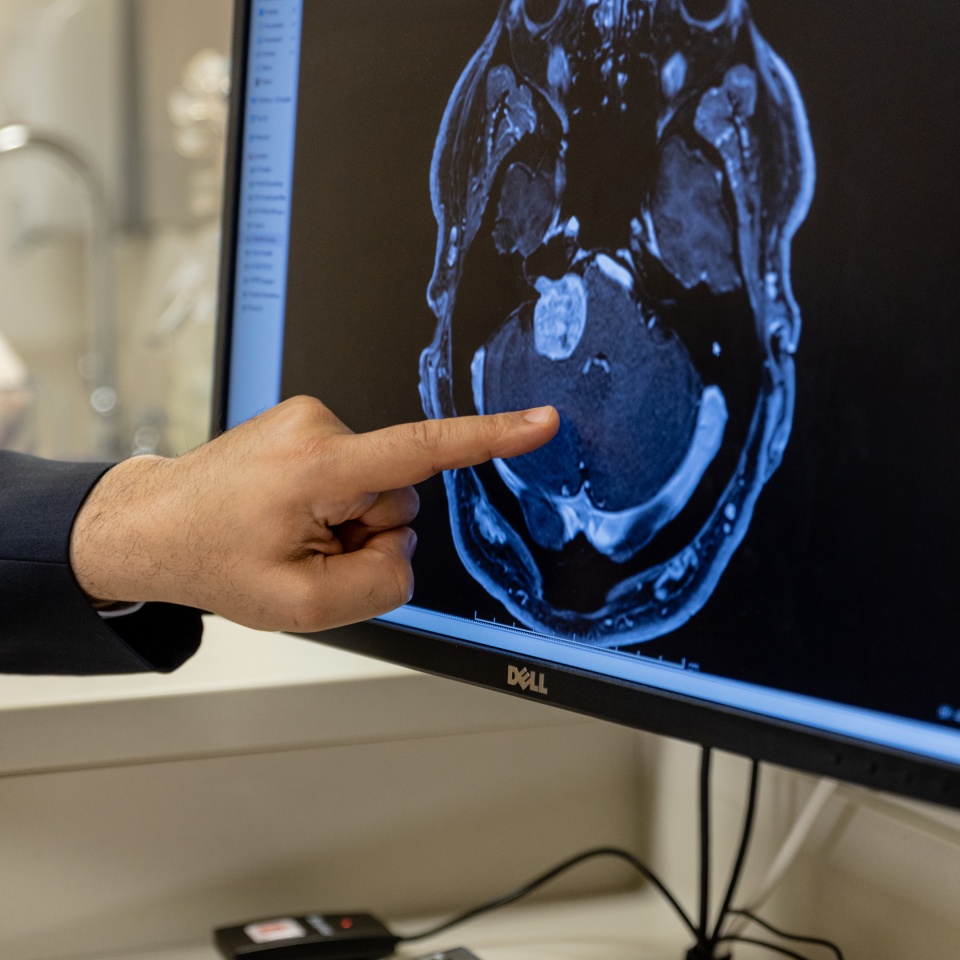
- High-resolution pituitary MRI with contrast
- Inferior petrosal sinus sampling (IPSS) when MRI findings are unclear
Some ACTH-producing tumors are too small to appear clearly on even high-quality MRI. In those cases, inferior petrosal sinus sampling measures ACTH in the veins draining the pituitary gland to confirm that the tumor is pituitary in origin. Dr. Cohen-Gadol works closely with each patient’s endocrinologist to interpret hormone testing and imaging together, and patients can upload their MRI or CT for review before a consultation.

Treatment Options for Cushing’s Disease
The goal of treatment is to bring cortisol back to normal levels, reverse the effects of excess cortisol as much as possible, and preserve healthy pituitary function. The right approach depends on tumor size and location, hormone testing, overall health, and whether the patient has had prior treatment.
Endoscopic Transsphenoidal Surgery
For most patients, surgical removal of the pituitary tumor is the first-line treatment. Using endoscopic skull base surgery, Dr. Cohen-Gadol reaches the pituitary gland through the nasal passages and the sphenoid sinus, with no external incision on the face or scalp. A high-definition endoscope provides a wide, magnified view of the gland, while intraoperative navigation guides each step relative to the carotid arteries and optic nerves nearby.
When performed by an experienced pituitary surgeon, transsphenoidal surgery leads to remission or significant symptom improvement in roughly 80 to 85 percent of patients, with the most favorable results typically seen in smaller, well-defined tumors. Outcomes vary with each patient’s anatomy and tumor characteristics.
“With Cushing’s disease, the tumor may be only a few millimeters across, and sometimes it hides from even the best imaging. Careful exploration of the gland and a precise understanding of its subtle anatomy play a major role in achieving remission.” — Dr. Cohen-Gadol
Medical Therapy
Medications can lower cortisol production, reduce ACTH release from the tumor, or block cortisol’s effects on the body. These medications are typically prescribed and managed by an endocrinologist and may be used to control symptoms before surgery, when surgery is not an option, or when cortisol remains elevated after surgery. Medical therapy manages cortisol levels but does not remove the underlying tumor.
Radiation Therapy and Stereotactic Radiosurgery
Radiation may be recommended for residual or recurrent tumor that cannot be safely removed. Stereotactic radiosurgery delivers highly focused radiation in one or a few sessions, while conventional radiation is given in smaller doses over several weeks. The hormonal effects of radiation develop gradually over months to years, and patients are monitored for reduced pituitary hormone function afterward.
Repeat Surgery and Additional Options
When Cushing’s disease persists or returns, a second transsphenoidal operation may offer another opportunity for remission, and Dr. Cohen-Gadol regularly evaluates patients for recurrent and reoperation cases. In select situations, removal of both adrenal glands may be considered to stop cortisol production directly, an option that requires lifelong hormone replacement and ongoing monitoring of the pituitary tumor.
What to Expect Before and After Pituitary Surgery
Care begins with a thorough consultation, where Dr. Cohen-Gadol reviews imaging, hormone testing, and medical history, explains the findings in clear terms, and outlines a personalized plan in coordination with the patient’s endocrinologist. Surgery is performed under general anesthesia, and most patients remain in the hospital for a short stay, often one to two days, for monitoring of hormone levels and fluid balance.
A sharp drop in cortisol after surgery is often an early sign that the tumor was successfully removed. Because the rest of the pituitary gland needs time to resume normal function, most patients take temporary steroid replacement for several months or longer while their natural cortisol production recovers. Some patients experience temporary nasal congestion, fatigue, or increased thirst and urination during the first weeks. Physical changes such as weight, skin, and muscle strength typically improve gradually over many months, and long-term follow-up with periodic hormone testing is important because Cushing’s disease can recur years later. Anyone experiencing a sudden severe headache, sudden changes in vision, or signs of adrenal crisis such as severe weakness, vomiting, dizziness, or confusion should call 911 or go to the nearest emergency room. The information on this page is educational and does not replace an individualized evaluation.

Frequently Asked Questions About Cushing’s Disease
-
Cushing’s syndrome refers to high cortisol levels from any cause, including steroid medications and adrenal tumors, while Cushing’s disease refers specifically to cortisol excess driven by an ACTH-producing tumor in the pituitary gland.
-
Nearly all tumors responsible for Cushing’s disease are benign adenomas, but the excess cortisol they trigger can cause serious health effects over time, which is why treatment is typically recommended once the diagnosis is confirmed. Learn more about pituitary tumors and how they are treated.
-
In experienced hands, transsphenoidal surgery leads to remission or meaningful symptom improvement in roughly 80 to 85 percent of patients, with results influenced by tumor size, visibility on MRI, and whether the tumor has invaded surrounding structures.
-
Some ACTH-producing tumors are too small to see on imaging, so specialized testing such as inferior petrosal sinus sampling can confirm a pituitary source, and an experienced surgeon can then carefully explore the gland during endoscopic skull base surgery.
-
Most patients return to light daily activities within a few weeks, though full recovery from the effects of long-term cortisol excess, including weight, energy, and mood, often unfolds over six months to a year or more.
-
Yes, Dr. Cohen-Gadol regularly reviews imaging for patients across the country and internationally, and the Out-of-Town & International Patients team and Fly-In Program help coordinate virtual consultations and travel for surgery.

Why Patients Choose ATLAS Institute for Cushing’s Disease Care
Patients with Cushing’s disease need a surgeon who understands both the delicate anatomy of the pituitary gland and the hormonal complexity of the condition. ATLAS Institute offers:
- Extensive Skull Base Experience: More than 7,500 complex brain surgeries inform every step of pituitary tumor removal.
- Endoscopic Precision: Minimally invasive transnasal approaches designed to protect the normal gland and nearby nerves.
- Coordinated Endocrine Care: Close collaboration with endocrinologists on diagnosis, hormone replacement, and follow-up.
- Access for Patients Everywhere: Remote MRI review, virtual consultations, and travel support for patients outside California.
Schedule a Cushing’s Disease Consultation in Los Angeles
Living with Cushing’s disease can feel exhausting, especially after months or years of searching for answers, and the right surgical expertise can help you move forward with confidence. Dr. Cohen-Gadol welcomes patients from Los Angeles, Beverly Hills, and across the world to ATLAS Institute of Brain & Spine for thorough evaluation, second opinions, and personalized treatment planning. Call (310) 626-1312 or request a consultation to begin your path toward lasting hormonal balance and renewed health.
Medically reviewed by Aaron A. Cohen-Gadol, MD, MSc, MBA on